Thought Provokers

Enemies of Innovation
Dr. Calestous Juma’s new book, “Innovation and its Enemies: Why People Resist New Technologies” (2016), explains that this is a book Dr. Juma has wanted to write since his early engagement with innovation. That includes his founding of the African Centre for Technology Studies in 1988, being a former Executive Secretary of the UN Convention on Biological […]

Two Faces of Civil Society
A number of authors promote civil society as a mechanism to improve aid: Dwyer (2015) argued it as an alternative to traditional, top-down aid, Roy, Negron-Gonzales, Opoku-Agyemang and Talwalker (2016) as poor people’s movements, Eyben (2014) of the people-centered alternative vision of civil society, and Acemoglu and Robinson (2006) about the necessity of collective action for democratic […]
Tags: #Civil society #Effective aid #International development #NGOs #Politics

Encountering Development
One of the books commonly cited and recommended in critical development studies circles is Arturo Escobar’s Encountering Development: The Making and Unmaking of the Third World (1995). Escobar is a Colombian-American Anthropologist, who interestingly started his academic career in chemical engineering. The award-winning book is typically summarized as reframing ‘development’ as a tool of control […]
Tags: #Accountability #Critical Studies #Development discourse #Encountering Development #International development

Envisioning Power
Anthropologist Eric Wolf (1923-1999) last book, Envisioning Power: Ideologies of Dominance and Power (1999) is not his most well-known work, but is a book that should be read by those seeking to understand how anthropological studies, and comparative cultural studies, can contribute to our understand of power and politics and their relation to ideas and […]
Tags: #Anthropology #Culture #Ideology #Interdisciplinary #Power
Encountering Poverty
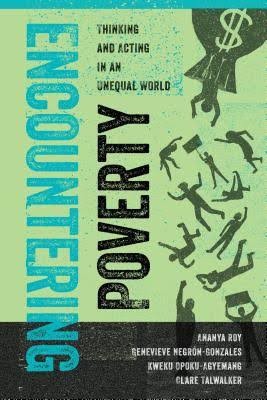
The 2016 book “Encountering Poverty: Thinking and Acting in an Unequal World” brings together some of the insights draw from teaching in a critical undergraduate program. Roy, Negron-Gonzales, Opoku-Agyemang and Talwalker offer something between an edited volume and an undergraduate textbook, while also offering critical reflexivity of their own roles and positionality. The target audience […]
Tags: #Complexity #Education #International development #Poverty #Reflexivity

Sweetness and Power
The American Anthropologist Sidney Mintz (1922-2015) spent a career understanding and writing about the intersections between food, slavery and colonialism, largely in the Caribbean. His book Sweetness and Power (1985) is one of the most widely read and influential books in cultural anthropology. Mintz takes Anthropologists to task for often being ahistorical, in the introduction […]
Tags: #Colonialism #Food #Power #Slavery #Sugar

World-system Analysis
Immanuel Wallerstein, an American sociologist at Yale, developed the world-systems approach, which he has written about and developed for more than four decades –first published in The Modern World-System in 1974. In 2004 he authored World-Systems Analysis: An Introduction as a means to present the theory in a concise way, largely for those unfamiliar with […]
Tags: #Capitalism #Immanuel Wallerstein #Interdisciplinary #Participation #World-system

Does Development Aid Violence?
Peter Uvin’s “Aiding Violence: The Development Enterprise in Rwanda” (1999), should be read by all students, practitioners and scholars of development studies. The book offers unique perspectives on the linkages between development activity and politics, power, exclusion, marginalization and processes that generally counter the objectives of the development enterprise, and specifically the Rwandan genocide.The book […]
Tags: #Aid #Development Studies #Genocide #International development #Violence

Contesting Power
Acemoglu and Robinson’s Why Nations Fail (2012) offers insight into why wealth and poverty exists (see post here). It also provides direction as to how more inclusive political and economic institutions are formed, which draws on their 2006 book, On the Origins of Democracy and Dictatorship. They open with a comment about the Arab Spring: […]
Tags: #Democracy #Inclusive #Institutions #Power #Rule of law
Why Nations Fail
Why Nations Fail (2012), by Acemoglu and Robinson, is probably one of the most influential development studies books of the last decade. Although the idea itself is not new, the authors make a details and persuasive argument that institutions are a primary reason for national wealth and poverty. They write: “The central thesis of this […]
Tags: #Economic growth #Institutions #Politics #Power #Why Nations Fail
About me

Logan Cochrane
Logan is a Professor at HBKU in the College of Public Policy. He is an Associate Fellow of the Ethiopian Academy of Sciences and an Adjunct Professor at Hawassa University (Institute for Policy and Development Research). Over the last twenty years, he has worked in Afghanistan, Benin, Burundi, Canada, the Democratic Republic of the Congo, Egypt, Ethiopia, Qatar, Saudi Arabia, South Africa, South Sudan, Tanzania and Uganda. Logan acts as a consultant for governmental agencies and non-governmental organizations, seeking to create bridges between research and practice.
Featured Posts
Tags
Africa Agriculture Anthropology Books Capitalism China Civil society Climate change Colonialism Colonization Conflict Culture decolonization Democracy Development Development Studies Economics Education Ethics Ethiopia Ethnography Fellowship Food Security Gender Globalization Governance History Human Rights Inequality Interdisciplinary International development Islam Leadership Middle East Migration Participation Philosophy Policy Politics Post-doc Poverty Power Qatar Racism Resilience Revolution Rural Development Sociology South Africa SustainabilitySubscribe to receive new blog posts via email