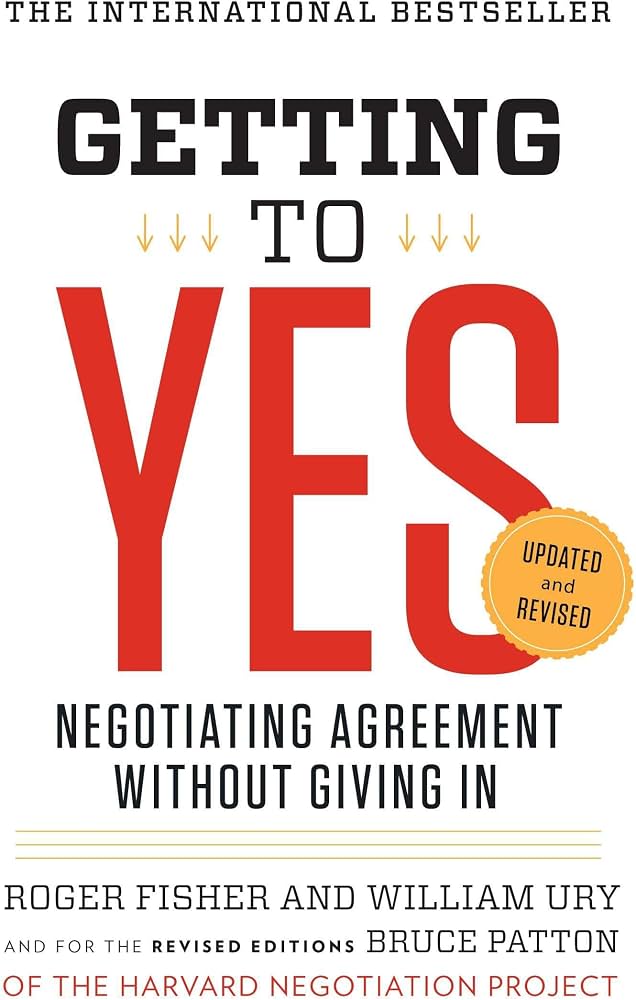
This 1981 classic by Fisher and Ury was given to me as a gift when starting a new leadership role. “Getting to Yes: Negotiating Agreement Without Giving In” is not only a best seller, it has seeped into popular culture as a reference point for negotiation. A few notes:
“… in contrast to positional bargaining, the principled negotiation method of focusing on basic interests, mutually satisfying options, and fair standards typically results in a wise agreement. The method permits you to reach a gradual consensus on a joint decision efficiently without all the Transactional costs of digging in to positions only to have to dig yourself out of them. And separating the people from the problem allows you to deal directly and empathetically with the other negotiator as a human being regardless of any substantive differences, thus making possible an amicable outcome. ” (p. 14-15)
“In most negotiations there are four major obstacles that inhibit the inventing of an abundance of options: (1) premature judgment; (2) searching for the single answer; (3) the assumptions of a fixed pie; and (4) thinking that “solving their problem is their problem.” To overcome these constraints, you need to understand them.” (p. 59)
“The reason you negotiate is to produce something better than the results you can obtain without negotiating. What are those results? What is that alternative? What is your BATNA — your Best Alternative To a Negotiated Agreement? That is the only standard that can protect you both from accepting terms that are too unfavourable and from rejecting terms it would be in your interest to accept. Your BATNA not only is a better measure but also has the advantage of being flexible enough to permit the exploration of imaginative solutions. Instead of ruling out any solution which does not meet your bottom line, you can compare a proposal with your BATNA to see whether it better satisfies your interests.” (p. 102)
“”Learn from Doing. A book can point you in a promising direction. By making you aware of ideas and aware of what you are doing, it can help you learn. No one, however, can make you skillful but yourself. Reading a pamphlet on the Royal Canadian Air Force fitness program will not make you physically fit. Studying books on tennis, swimming, riding a bicycle, or riding a horse will not make you an expert. Negotiation is no different.”” (p. 149)