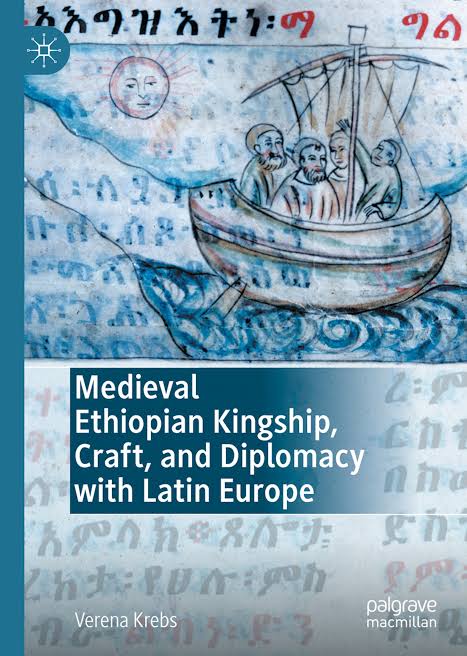
Verena Krebs authored a unique and rich historical text on the rationale and motivation of Ethiopian leadership to send off international delegations, particularly to Europe, in the Middle Ages. “Medieval Ethiopian Kingship, Craft, and Diplomacy with Latin Europe” (2021, Palgrave) is extensively researched. The author has a PhD from both Germany and Ethiopia. For historians, this is a gem. Some notes:
“Between 1400 and the late 1520s, successive Ethiopian sovereigns are recorded as dispatching at least a dozen diplomatic missions to various princely and ecclesiastical courts in Latin Europe. The vast majority of embassies were sent out within the first 50 years of contacts. In the fifteenth century alone, Solomonic envoys arrived at places as varied as Venice, Rome, Valencia, Naples and Lisbon. Ethiopian pilgrims, sometimes cast into the role of inadvertent ambassadors, are concurrently attested from Lake Constance in modern day Germany to Santiago de Compostela in the very West of the Iberian Peninsula… Examining late medieval Solomonic Ethiopian missions to the Latin West, this book above all seeks to answer a simple question: why did generations of nagast initiate diplomatic contacts with different princely and ecclesiastical courts in Europe in the fifteenth and early sixteenth century?” (p. 3)
“… not a single source relating to the first 100 years of Ethiopian diplomacy portrays a clear Solomonic interest in obtaining military craftsmen-technologists or alliances, arms or guns from the Latin West. Instead, we find an immense desire to acquire foreign religious material culture, especially relics, ecclesiastical fabrics and liturgical objects, but also artisans and craftsman skilled in trades necessary to construct magnificent architectural monuments – builders, carpenters, stonemasons, metalworkers, painters.” (p. 5-6)
“Led by a charismatic commander called Imam Ahmed Ibn Ibrahim al-Gazi, the ‘Adali forces managed to overrun most of the Solomonic Christian Kingdom by 1530-1531. In 1535, at the height of the conflict, dispossessed most of his realm and in hiding, ase Lebna Dengel sent a frantic call for aid to the papacy and Portugal. Among other things, he promised to recognize the Pope and enter into a Union of the Churches with Rome in exchange for help. Desperate, his ambassador begged the Lusitanian crown for soldiers and firearms. In the early 1540s, Portuguese troops arrived and eventually turned the tide of the war for the Solomonic side. Yet the dynamics of the Ethiopian Latin Christian relations were to be forever altered: about a third of the 400 Portuguese soldiers chose to stay in the Ethiopian highlands.” (p. 154)
“… Ethiopia’s diplomatic outreach to Latin Europe also shines a new light onto a late medieval African dynasty at the height of its power. The image emerging from the textural and material record is not one of an indigent, powerless or even passively receptive kingdom in the late Middle Ages. Instead, we find a mighty African realm addressing its peers in the voice of a self-confident Christian empire. Solomonic rulers encountered the world on their own terms.” (p. 266)