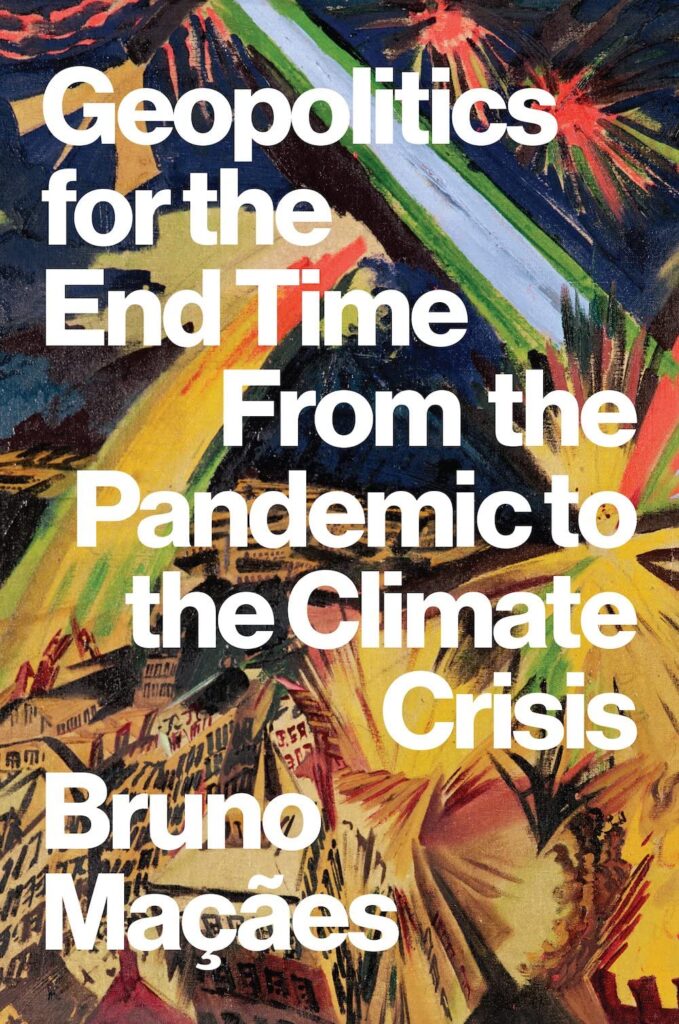
Former Secretary of State for European Affairs for Portugal, political philosopher Bruno Macaes has penned several books (and is frequently a public commentator). These notes reflect on Geopolitics for the End Times: From the Pandemic to the Climate Crisis (2021). This is the first of his books I have read, and it may not have been the best place to start. This book was written during the COVID19 pandemic and is very situated in that moment. Chapter 1, which is a quarter of the book, is on the pandemic response. While there are some lasting notes, the large share of the book focuses on the details of 2020 and 2021; one would have hoped to have the more lasting reflections taken a greater prominence to give the book more lasting relevance for readers. A few notes:
“There are many kinds of wars between states, fought for many reasons, and sometimes for no reason at all. The wars that shape history are those fought for the sake of the world order, such as the war between Athens and Sparta chronicled by Thucydides. There are wars, one could say, upon which the very fate of the world depends; What is at stake and what will be decided by the outcome is how world politics should be organized, according to which principles and values and, no less importantly, which hierarchy. Pattern has been repeated many times throughout human history. A dominant state or empire, no matter how powerful, it will be challenged by a new rising power, and, as the differential between them is reduced or disappears, the existing order becomes increasingly unstable.” (p. 65)
“… In a game the competitors or opponents are inextricably linked together. They are brought together in the same space and their goals and actions have been defined in such a way that they encroach or impinge on each other. They act in the same generalized environment. This is increasingly the case for state actors today. They are so dependent on each other and so tightly connected as links in global networks that they cannot but feel vulnerable, and may not resist the temptation to move first in order to avoid or minimize the consequences of what others decide to do full stop this is the main and most lasting consequence of the coronavirus pandemic. It has inaugurated a world cutthroat competition for resources, where disaster lurks and where citizens must rely on their states for security and prosperity.” (p. 185)