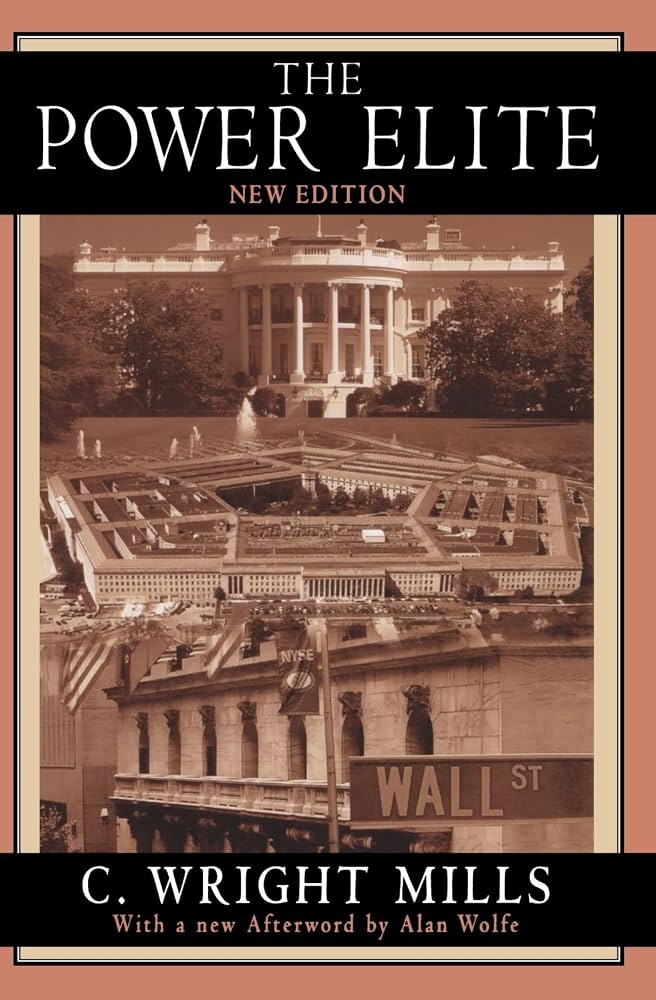
This OUP book, originally published in 1956 by Mills, analyzes the forms and sources of power in the American landscape. The chapters present layers of power in society, from local powers, to celebrities, wealthy, corporations, military, political elite, etc. Undoubtedly, power has changed since the early 1950s, however this book still seems worth reading. It provides context to see the changes in power, and for non-American readers a glimpse into the complexities of power, which is often simplified. Some notes:
“The power elite are not solitary rulers. Advisors and consultants, spokesmen and opinion makers are often the captains of their higher thought and decision. Immediately below the elite are the professional politicians and the middle levels of power, in the Congress and in the pressure groups, as well as among the new and old upper classes of town and city and region. Mingling with them, in curious ways which we shall explore, are those professional celebrities who live by being continually displayed but are never, so long as they remain celebrities, displayed enough. If such celebrities are not at the head of any dominating hierarchy, they do often have the power to distract the attention of the public or afford sensations to the masses, or, more directly, to gain the ear of those who do not occupy positions of direct power. More or less unattached, as critics of morality and technicians of power, as spokesmen of God and creators of mass sensibility, such celebrities and consultants are part of the immediate scene in which the drama of the elite is enacted. But that drama itself is centered in the command posts of the major institutional hierarchies.” (p. 4)
“It is not my thesis that for all epochs of human history and in all nations, a creative minority, a ruling class, an omnipotent elite, shape all historical events. Such statements, upon careful examination, usually turn out to be mere tautologies, and even when they are not, they are so entirely general as to be useless in the attempt to understand the history of the present. The minimum definition of the power elite as those who decide whatever is decided of major consequence, does not imply that the members of this elite are always and necessarily the history-makers; neither does it imply that they never are. We must not confuse the conception of the elite, which we wish to define, with one theory about their role: that they are the history-makers of our time. To define the elite, for example, as those who rule America is less to define a conception than to state one hypothesis about the role and power of that elite. No matter how we might define the elite, if the extent of its members power is subject to historical variation.” (p. 20)
“The public is quite used to the idea of vice, but it likes to think it involves only idle rich boys and poor country girls. The men involved in the vice of cafe society however, are by no means boys; They are not idle; They need not personally be rich; And they are not interested in poor or innocent country girls the women involved are not exactly girls; They may have come from smaller cities, but they are now very much big city; They are not innocent, and they are not exactly poor. One easily forgets that the underside of the glamour of cafe society is simply a service trade in vice. Those engaged in – it the producers, the prostitutes, the customers, who buy and sell assorted varieties of erotica service – are often known to their associates as quite respectable. And the all American girl, as a photographed image and as a person, is often a valued and indispensable helpmate to the Great American salesman.” (p. 82)
“Undue attention to the middle levels of power obscures the structure of power as a whole, especially the top and the bottom. American politics, as discussed and voted and campaigned for, have largely to do with these middle levels, and often only with them. Most ‘political’ news is news and gossip about middle level issues and conflicts. And in America, a political theorist too is often merely a more systematic student of elections, of who voted for whom. As a professor or as a freelanced intellectual, the political analyst is generally on the middle levels of power himself. He knows the top only by gossip, the bottom, if at all, only by ‘research’. But he is at home with the leaders of the middle level, and, as a talker himself, with their ‘bargaining’.” (p. 245)