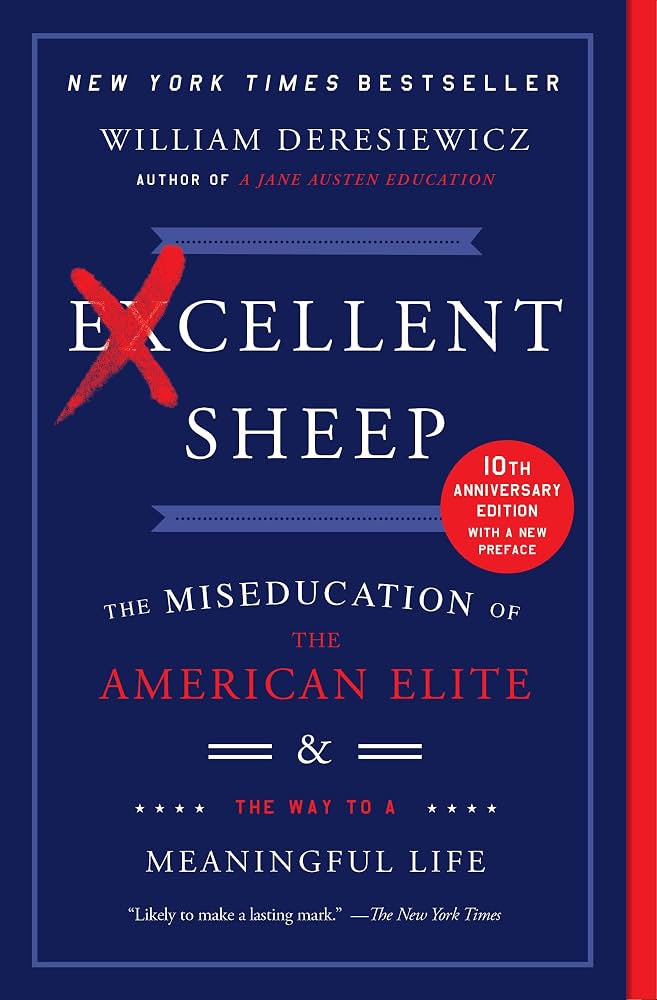
Starting from a viral essay, the 2014 book “Excellent Sheet: The Miseducation of American Elite” by Deresiewicz presents a critique of a system. The short take away might be a critique of the elite schools, but the critique is broader (why generations scramble to live a performative life without purpose). My notes don’t focus on the social critique, for those interest in that start with the original essay, rather the notes focus on the “so what next?” after we accept the critique:
“The system manufacturers students who are smart and talented and driven, yes, but also anxious, timid, and lost, with little intellectual curiosity and a stunted sense of purpose: trapped in a bubble of privilege, heading meekly in the same direction, great at what they’re doing but with no idea why they’re doing it.” (p. 3)
“So how do you find your vocation – or as people like to say today, your passion? That can be the hardest question that young people face, especially after being trained to think exclusively in terms of the next immediate goal. There are no easy answers, but here are a few suggestions. Do for work what you do spontaneously – or did spontaneously, back when you were younger, before all the spontaneity got beaten out of you. Do what you would choose to do anyway, even if you didn’t get rewarded for it. Do the thing that you can immerse yourself inside for hours at a time. You know the thing you wish you could do, instead of what you’re doing now? Just do that thing. Do what you love to do most: no, not that – not what you think you love, or think you ought to love, but what you really do love.” (p. 97)
“The world is not fair, even though it should be. The genetic lottery is not fair and never will be. Having the freedom to invent your life is a privilege. Being able to follow your passion might be the ultimate form of entitlement. But decrying these facts does not eliminate them. I recognize that what I’m saying does not apply to every student or prospective student at an elite school, still less to those at other schools. The question is, does it apply to you? If so, the fact that others are less fortunate does not let you off the hook. Quite the contrary.” (p. 119)
“Great teachers, as Andrew Hacker and Claudia Dreifus remarked, are not bound by disciplinary ideas of what they’re allowed to say. They connect the material at hand, in a way that feels spacious and free, with everything to which it might be relevant. They connect it to experience, and so they shed light on experience – on your experience. Just as great art gives you the feeling of being about life – about all of it at once dash so does great teaching. The boundaries come down, and somehow you are thinking about yourself and the world at the same time, thinking and feeling at the same time, instead of seeing things as separate parts, you see them as a whole. It doesn’t matter what the subject is, a student put it to me this way, about a professor in an oceanic studies program: “He made marine ecology reflect universal truths.” You know great teaching the moment you encounter it. Yes, you feel, that is it – this is what I came for. It reaches deep inside you it satisfies desires you didn’t know you had. It makes the world feel newly larger and meaningful dash exactly, again, like art. The other thing that students say about their favorite teacher is “he changed my life.”” (p. 180)