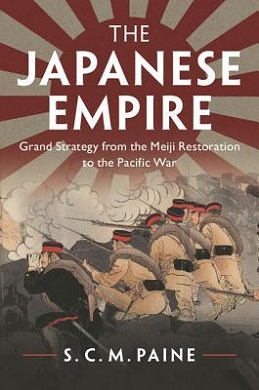
Published by Cambridge University Press, this 2017 book (The Japanese Empire: Grand Strategy from the Meiji Restoration to the Pacific War) was written by US Naval War College Professor S. C. M. Paine. The book notes some of the enabling factors for Japanese success, ranging from risk taking (p. 26), to rapidly expanding transportation infrastructure (p. 24), military buildup (p. 8) and domestic perception management (p. 39). A few notes:
“Few nations have solved the conundrum of economic development. Yet the Japanese in the late nineteenth century became experts at economic development and their story has much to offer others concerning both the prerequisites and the pitfalls of transforming a traditional society into a modern country. Japanese leaders modernized and westernized their homeland in order to defend against the predations of increasingly intrusive Western Powers.” (p. 1)
“As Japanese leaders observed these events with growing horror, some rapidly concluded that they needed to learn more about the nature of the threat. Serious study of the west began in 1857 with the Tokugawa shogunate’s establishment of the Institute to Study Western books – a think tank of its era. Government missions abroad soon followed. Not only the central government but also the large domains sent students abroad, initially to study law, navigation, and medicine, but the fields of inquiry rapidly expanded to encompass the full array of Western institutions, both military and civil.” (p. 4)
“The Meiji generation’s overarching objective was the preservation of Japan’s security and independence in the face of accelerating Western and Russian imperialism. Since empire was the hallmark of a great power at that time, Japan would follow the model. They devised a sequential grand strategy: first a domestic phase of institution building, followed by a foreign-policy phase of wars to win an empire. Domestic reforms would both lay the foundations for Japan to become a great power and also remove restrictions of the treaty port system, impinging on its sovereignty. Wars would both stake a claim to an empire on the Asian mainland and also contain Russian expansion that would preclude empire. A key 1873 document makes this sequence clear: “The first thing is to revise the treaties [with European powers], the Korean businesses [The conquest of Korea] comes after that.”” (p. 8)
“Sea powers tend to have many allies, whereas land powers tend to have few – another element for sea powers’ resilience. This is because the evolving maritime global order favored by sea powers is a positive-sum order in the pursuit of economic growth, which all members can share. The maritime order is based on freedom of navigation freedom of trade, and a growing body of a international law and set of international institutions to regulate the transportation, communication, and diplomacy that the trade requires. In contrast, continental powers generally have few friends because theirs is a negative-sum global order based on the domination of territory by one country at the expense of the other.” (p. 78)
“Botched war termination in regional wars usually produces one out of two outcomes: either the war protracts when the weaker belligerent launches an insurgency with economy-killing and budget-busting consequences for the counterinsurgent or the war escalates when an interested third party intervenes on the opposing side. The most common way to avoid such unpleasant eventualities is to offer peace terms generous relative to the military disposition of forces. The need to offer a generous peace is particularly important for the invading power because the value of victory is usually considerably higher for those living in theater than for those intervening from afar. This means a greater likelihood for those in theater to endure high costs and protraction.” (p. 143)