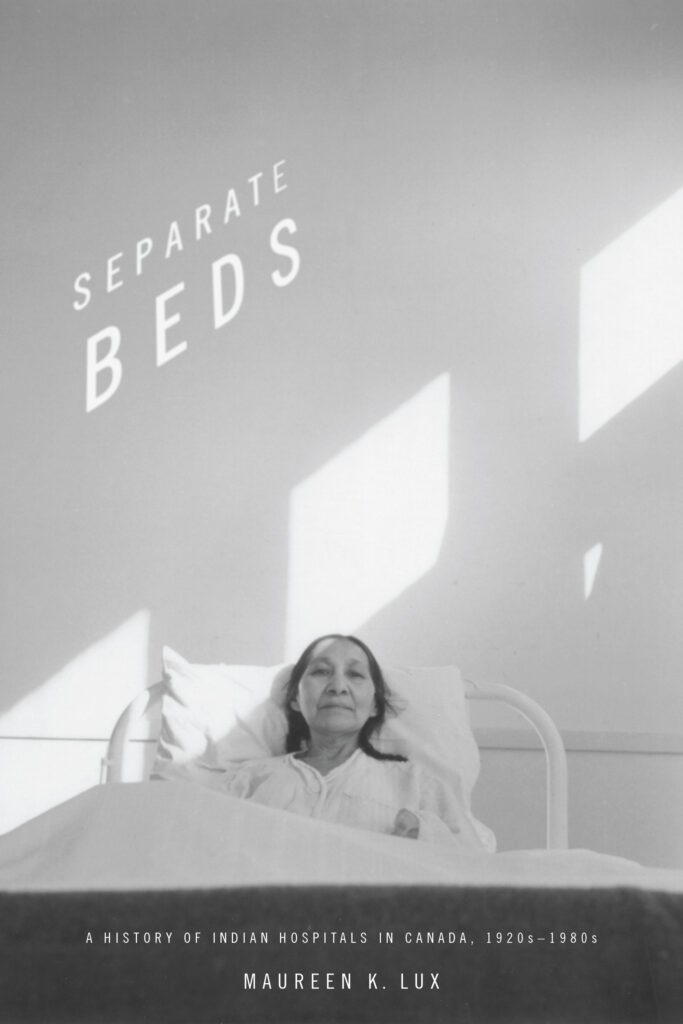
In Afrikaans, ‘apartheid’ means apartness or separateness. Maureen Lux examines the history of medical apartheid in Canada in the book “Separate Beds: A History of Indian Hospitals in Canada, 1920s-1980s” (2016), published by the University of Toronto Press. The author is a professor of history. A few of the chapters draw on published materials (articles). Similar to South Africa, what never ceases to astonish is the effort to which white supremacy is manufactured, perpetuated and enforced through policy and law. A few notes:
“Indian hospitals emerged from deep anxieties about Aboriginal people and their perceived threat to the public’s health. Initially begun in concert with mission schools to keep ill children within the Christian embrace, with uneven support from the state, mission hospitals provided limited care to a “dying race”. Literally and figuratively, through disease, isolation on reserves, and particularly the assimilationist policies in schools, Indians were expected to disappear as Canada embraced modernity in the twentieth century. That they did not, and indeed increased their presence in towns and cities, created considerable concern. By the 1930s, medical discourse shifted from civilization’s supposed deleterious influence on Aboriginal people to the threat Aboriginal illness posed to the nation’s health. With an increasingly strident rhetoric of the threat of “Indian tuberculosis”, sanatorium directors working with provincial physician bureaucrats, pushed the federal state to protect society by creating Indian hospitals. Formalizing an already well entrenched system of racially segregated care, Indian hospitals also made it seemingly natural that the sanatorium and the modernizing hospital would be reserved for white patients.” (p. 19)
“The history of “separate beds” for Aboriginal people complicates our understanding of twentieth century health care in Canada. Indian hospitals stood alongside more modern white counterparts, putting racial segregation at the core of the nascent welfare state.” (p. 191)
“The history of Indian hospitals and health care policy since the 1920s reveals the limits of Canada’s liberal democracy. Colonized in the interest of nineteenth century state formation, Aboriginal people were marginalized in the construction of the welfare state. Lines of segregation and isolation, tended by the power of the state, and rationalized in the language of medical humanitarianism, did not negate Canada’s liberal democratic values. In fact they were integral to the formation of national health as normal white citizenship. More than half a century of contradictory and arbitrary policies that served the interests of the non-aboriginal population left a destructive legacy in aboriginal communities and beyond. Health disparities – constructed not found – have come to be seen as normal or inevitable.” (p. 197)