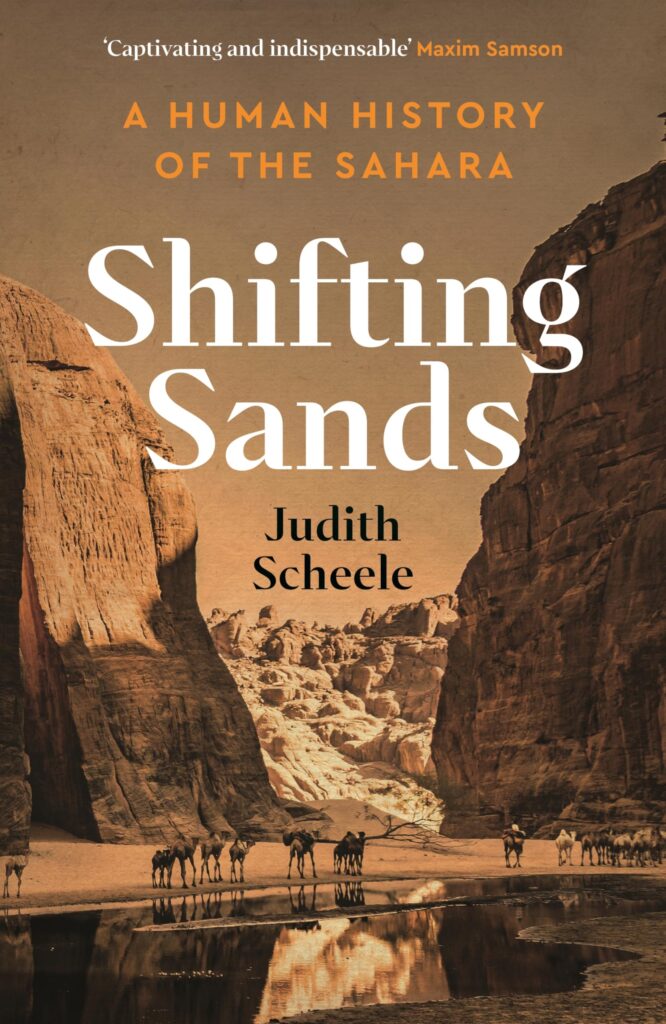
Judith Scheele is an anthropologist who has spent decades across the Sahara. This book project, Shift Sands: A Human History of the Sahara (2025) appears to have begun at least a decade before. The book is less a human history, and more an introduction to the peoples and livelihoods of the Sahara, as viewed from her experiences and interactions. The book weaves in some history, but it is not an academic work of history (or anthropology). My assumption is that she was aiming to offer a book for a broader readership who have not encountered the region or the peoples who live within it, and in so doing use those stories to inspire critical self reflection. My notes are more about those broader points:
“One of the most glaring differences between American and Saharan slavery has to do with race. CNN’s rendering of events in Libya strongly associated the idea of slavery with racism. Racial distinctions matter in the contemporary Sahara and have clearly mattered across the region at least since the seventeenth century. As in the Americas, they are deeply entangled with the history of slavery. But there are important differences. ‘Race’ is a historically constituted category (there is nothing ‘natural’ about it) that cannot be simply generalized globally and projected onto the deep past. To do so is to naturalize it and on some level to accept its assumptions. Instead, we need to understand how it works from the inside out in a given context and see it as what it is: a form of political domination.” (p. 128-129)
“‘Tribe’ is a complicated term and should be used with much caution. Since colonial times, it has been employed to denigrate certain populations, to imply that they live in a ‘lower’ or ‘less evolved’ phase of social and political evolution. ‘Tribe’ used in this sense is a fiction. It corresponds not to actual fact, nor indeed to local self-descriptions, but rather to a putatively universal evolutionary grid ranging from ‘simple’ to ‘state’ societies. As such there can be no use for the term. In a few contexts however, the Sahara among them, the term does correspond to local categories, and it is therefore difficult to do without. In a very different setting, the British historian E. P. Thompson famously distinguished between class as an external ascription (a group defined by its place in a broader system of property relations) and a class of a conscious feature of self-definition: between a ‘class in itself’ and a ‘class for itself’. ‘Tribe’ is too vague a category to correspond to any reality ‘in itself’, yet we can find tribes that exist for themselves, inasmuch as people proudly define themselves as belonging to them. This also means that we need to extract the term from evolutionary suppositions and carefully reconstruct its meaning from the bottom up, based on historical evidence. If we do this for the Sahara, we can see the many different kinds of groups that have been referred to or refer to themselves as ‘tribes’, ranging from small independent village federations to large and only loosely bound groups of hundreds of thousands of people.” (p. 250-251)
“To question old models, we need new ideas. And to have new ideas, we need to be able to see beyond the old ones, to reflexively move outside ourselves. Often, this can only be done if we change positions, move away from the self-evidence of the centre and look at the world from a more marginal perspective. This is also where Ibn Khaldun’s description of the desert beyond civilization as a ‘land of dissidents’ takes on broader meaning: if much of our current predicament is in fact a failure of the imagination, a failure to pay attention to others, then the unruly margins of long standing centers of civilizations might be a good place to remedy both, as they are unfamiliar enough to spark new thought and familiar enough to make sense of it.” (p. 337)