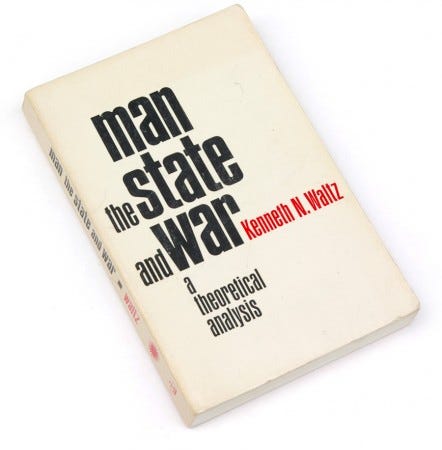
In 1954 Columbia University Press published what has become a classic read on understanding the cause of war. The book is philosophical in orientation, which aligns with the subtitle “Man, the State and War: A Theoretical Analysis”. Remains a useful read for anyone interested in a review of the ideas proposed on why war occurs. Some notes:
“To borrow the title of a book by Mortimer Adler, our subject is “How to Think about War and Peace.” The chapters that follow are, in a sense, essays in political theory. This description is justified partly by the mode of inquiry—we proceed by examining assumptions and asking repeatedly what differences they make—and partly by the fact that we consider a number of political philosophers directly, sometimes in circumscribed fashion, as with St. Augustine, Machiavelli, Spinoza, and Kant, and sometimes at length, as with Rousseau. In other places we shall concentrate on a type of thought, as in the chapters on behavioral scientists, liberals, and socialists. But what is the relevance of the thoughts of others, many of them living far in the past, to the pressing and awful problems of the present? The rest of the book is an answer to this question, but it is well at the outset to indicate the lines along which we shall proceed.” (p. 2)
“…our estimates of the causes of war are determined by our presuppositions as much as by the events of the world about us. A systematic study of the assumed causes of war then becomes a direct way of estimating the conditions of peace. Our primary concern has not been with building models from which policies promoting peace can be derived but with examining the presuppositions upon which such models are based. This puts the problem in academic terms.” (p. 224-225)