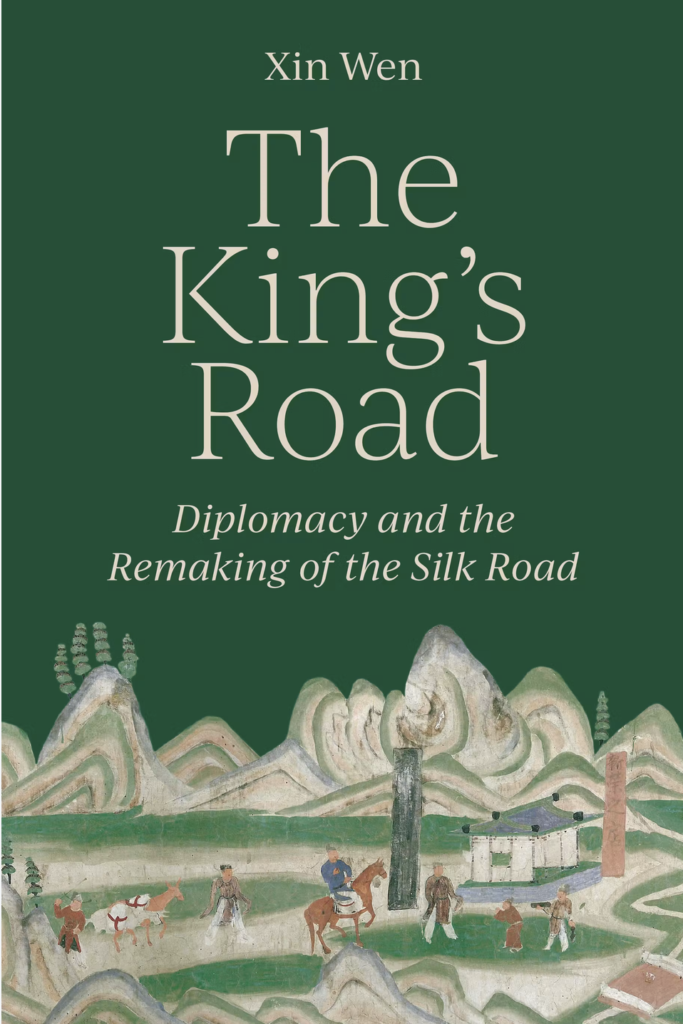
The subtitle of this book had me assuming the book “The King’s Road” would go in a different direction, which reads “Diplomacy and the Remaking of the Silk Road” (2023, Princeton University Press). The book is about remaking, the title is accurate; the remaking is our historical understanding of the “Silk Road” and – seemingly far too common – assumption that its primary function was trade. In this book Xin Wen shifts through a trove of historical documents that were recently discovered regarding the trans-Eurasian movement of ideas, people, diplomats and cargo between the years 850 and 1000. The book wades through historical nuances often lost to history and gives life to a time that, without the large set of documents recovered, would have remained invisible in history. A few notes:
“This book is a social history of the lives of these diplomatic travelers. By tracing their steps, observing their actions, and assessing their impact, the book investigates the organization and mechanisms of Eastern Eurasian international relations in the age of kings. Unlike earlier works of diplomatic history, I am not primarily concerned with military strategies and decision-making in court. Instead, my interest lies with more mundane matters: What did the envoys eat and drink? Where did they stay? How did they organize the logistics of transporting goods across the difficult terrain of Eastern Eurasia? How did they communicate, both orally and in writing, with people who spoke a different language? What diplomatic protocols did they follow? These matters open onto a set of larger questions about the political dimensions of this time. What motivated kings to engage in diplomacy? Was diplomacy critical to their idea of kingship, and if so, why? What motivated envoys to participate in diplomacy? The documents discovered in the Dunhuang cave provide the answers to these questions, and many others.” (p. 8)
“The kings of Eastern Eurasia were interested in the maintenance of the diplomatic network for a number of reasons. Because of the fiscal structure of their courts, the kings usually stood to personally benefit from the gifts exchanged with other kings; they also desired information that only envoys from distant lands could bring. The legitimacy of their rule was bolstered by an association with other kings, whether such association existed among equals or between two parties of distinctly different status. In Dunhuang, this foreign presence is reflected in the depiction of foreign rulers in the Buddhist caves. All these factors contributed to the eagerness of kings of eastern Eurasia to send envoys to other states.” (p. 259)
“… I do hope that the stories from the Dunhuang materials can help put the widespread and commonly accepted assumption of the commercial nature of the Silk Road into question. Scholars have long been a bit too ready to interpret ambiguous evidence as traces of commerce on the Silk Road. As a result, the presence of commerce in our sources is often assumed and exaggerated rather than demonstrated. By highlighting the diplomatic nature of some connections on the Silk Road, I hope this book will remind readers and scholars to be more cautious when encountering an object or a person that has traveled far in premodern Eurasia. Instead of immediately connecting them to merchants and commerce, one should be open to interpreting them in other possible social contexts, such as diplomacy.” (p. 293)