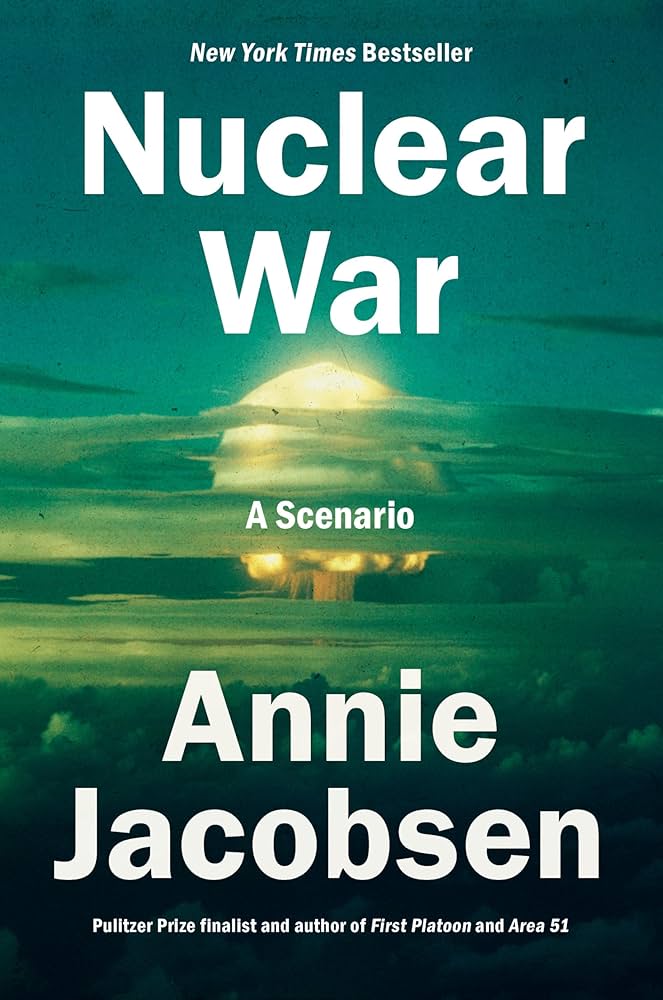
This 2024 book by Annie Jacobsen, “Nuclear War: A Scenario” is not an academic press and the author has written a number of book-length deep drives into topics with a more journalistic form. This one gives a brief history of the development of nuclear technology and weapons use, however it primarily is a minute by minute walk through of a nuclear war scenario from a US perspective. Basically the book walks through a “what if” scenario: who gets involved, when and what the decision processes look like. That was not exactly what I was looking for, but might be of interest for readers interested in security policy. Few notes:
“Deterrence guides nuclear policy. It works like this: each nuclear-armed nation builds an arsenal of nuclear weapons that it keeps pointed at its nuclear-armed enemy, ready to launch in a few minutes’ time. Each nuclear-armed nation vows never to use nuclear weapons unless they are forced to use them. Some people see deterrence as a peaceful savior. Others see it as doublespeak, asking, how could having nuclear weapons keep people safe from having a nuclear war? For decades, deterrence has allowed the Defense Department to build tens of thousands of nuclear weapons, their delivery systems, and a complex system of counter weapons to defend against nuclear attack. Trillions of dollars have been spent on nuclear weapons.” (p. 22)
“Over the years, its name has changed. What began as the Single Integrated Operational Plan is now the Operational Plan, or OPLAN. For the Nuclear Information Project, in concert with the Federation of American Scientists, project director Hans Kristensen and senior researcher Matt Korda have identified the current Operational Plan as OPLAN 8010-12. And it that it consists of “’a family of plans’ directed against four identified adversaries: Russia, China, North Korea, and Iran.”” (p. 27)
“One thousand, six hundred miles from Washington, D.C., in a field in Wyoming, a patch of hard packed snow shimmers in the afternoon sun. There is a chain link fence, motion detection equipment, and a 110-ton concrete door lying flush with the earth. Facing the sky. To passerby, this is cowboy country. Ranchers’ land. To Strategic Command, it’s ICBM silo country. Home to one-third of the nation’s 400 land based nuclear missiles. To those not in the know, the Echo-01 launch facility in this scenario is simply a non-descript cluster of buildings: house barn, electric tower, garage. But beneath the blast doors, hidden in the fields, sits an eighty-foot-deep missile silo tunnel with concrete walls that are four feet thick. An elevator shaft connects the launch crew to living quarters, a power station, and an escape tunnel so the two-person missile crew can get out after launch.” (p. 134-135)